Tidak Terkategori
Are Spare Tire Covers Worth It? The Honest Answer for 2026
Okt
Are spare tire covers worth it? For most Jeep, SUV, and RV owners who park outdoors regularly, yes — blocking UV exposure helps slow the rubber cracking that leads to premature spare tire replacement.
That said, a garage-kept vehicle with a rarely-touched spare may see little practical benefit beyond style.
Key Takeaways
- Radiasi UV accelerates rubber cracking and dry rot in tires over time — a cover directly addresses this.
- A spare tire left exposed to sun and weather degrades faster than one kept covered or stored indoors.
- A replacement spare tire typically costs noticeably more than a protective cover, making prevention cost-effective over time.
- PU leather and marine-grade vinyl both offer wipe-clean, UV-blocking surfaces — they are related but distinct materials.
- Covers are most valuable for outdoor-parked vehicles: Jeep Wranglers, SUVs, RVs, campers, and 4×4 trucks.
- Garage-kept vehicles with rarely-used spares gain little functional protection — for them, a cover is a styling choice.
- What a Spare Tire Cover Actually Does
- The Real Cost-Benefit Math
- When It’s Clearly Worth It
- When You Might Skip It
- Materials That Matter: PU Leather vs. Marine-Grade Vinyl
- Styling and Personalization Bonus
- Pertanyaan yang Sering Diajukan
What a Spare Tire Cover Actually Does
A spare tire cover’s primary job is shielding the rubber from the elements — and the biggest threat to an exposed spare is sun exposure. Tires are made from rubber compounds that break down when exposed to UV rays, heat, and ozone over time. Rubber dry rot is often associated with prolonged sun and ozone exposure over several years, and a spare mounted on the back of a Jeep Wrangler or SUV faces that punishment every single day.
Beyond UV blocking, a cover also keeps out road debris, mud, salt spray, and moisture — all of which matter especially during off-roading or towing. A spare that sits clean and dry under a cover is far less likely to surprise you with a cracked sidewall when you actually need it. That functional protection is the core reason most 4×4 and RV owners consider a tire protection accessory a practical purchase, not a luxury. If you’re shopping for one, a cover ban serep kustom built for your exact spare diameter will seal out the elements far better than a generic universal-fit option.
The Real Cost-Benefit Math
Whether spare tire covers are worth it often comes down to simple arithmetic: a replacement spare tire typically costs noticeably more than a protective cover, making prevention cost-effective over time. Mid-market spare tire covers sit at a price point well below what you’d spend on a new spare, mounting, and balancing — so even one avoided early replacement pays for several covers.
The math shifts if your spare never sees sunlight. If the vehicle lives in a garage and the spare is only touched during a roadside emergency every few years, the rubber degradation timeline stretches considerably. In that scenario, the cover’s value is mostly aesthetic. But for anyone who parks outdoors daily — in a driveway, a campsite, or a trailhead parking lot — the protective math works clearly in the cover’s favor.
| Scenario | UV/Weather Risk | Cover Value | Best For |
|---|---|---|---|
| Daily outdoor parking (driveway, street) | High | Strong functional + aesthetic | Jeep Wrangler, SUV, G Wagon owners |
| Off-roading / trail use | High (UV + debris) | Strong functional | 4×4 and overlanding rigs |
| RV / camper long-term outdoor storage | Very high | Essential | Pemilik RV dan camper |
| Garage-kept, rarely driven | Low | Primarily aesthetic | Style-focused owners |
| Boat trailer / utility trailer | Moderate–High | Functional + style | Trailer owners |
When Are Spare Tire Covers Worth It? Three Clear Scenarios
A spare tire cover delivers the most value in three situations: frequent outdoor parking, regular off-roading, and long-term RV or camper storage.
Outdoor-Parked Jeeps and SUVs
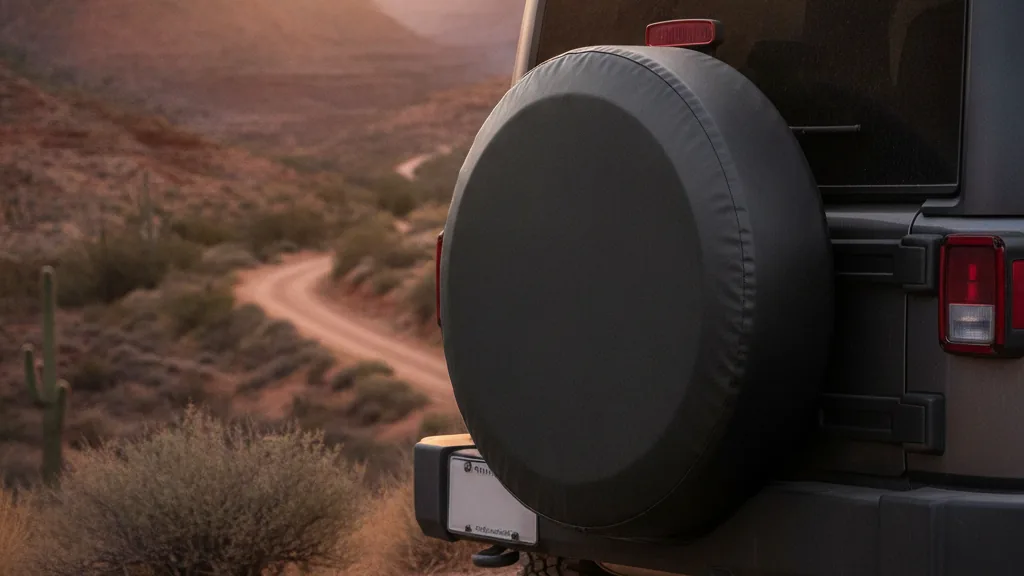
The Jeep Wrangler is the poster child for this category. Its rear-mounted spare sits fully exposed to the sky — no bumper overhang, no trunk lid, nothing between the rubber and the sun. Owners who park in driveways or on the street accumulate thousands of hours of UV exposure per year. A cover cuts that exposure dramatically, slowing the tire degradation that would otherwise shorten the spare’s usable life. The same logic applies to any SUV, Ford Bronco, or 4×4 with an externally mounted spare — Bronco spare tire covers follow the same exposed-mount design that makes a cover worthwhile.
If you own a Jeep, browse the Cover ban serep Jeep Wrangler collection to find designs built specifically for Wrangler sizing and mounting.
Off-Roading and Trail Use
During off-roading, the spare takes hits from mud, rocks, branches, and standing water. Dirt and debris pack into the tread and sit against the sidewall. A cover keeps the spare cleaner between trips and protects the rubber from abrasion. Off-road and 4×4 spare tire covers are built with this use case in mind — they need to stay put on rough terrain and wipe clean easily after a muddy run.
RVs and Campers in Long-Term Storage
Recreational vehicles often sit parked outdoors for weeks or months at a time. That extended sun exposure is exactly the condition that accelerates rubber cracking most aggressively. RV and camper owners arguably have the strongest functional case for a cover of any vehicle category. Camper spare tire covers are sized and designed for the larger spare diameters common on travel trailers and fifth wheels.
When You Might Skip It — The Honest Counterpoint
If a vehicle is garage-kept or the spare is rarely exposed to sun, rain, or road debris, a cover adds little functional protection. In that case it becomes purely a styling choice rather than a tire-saving investment. A daily driver that parks in a covered structure overnight, and only sees outdoor sun during commute hours, faces far less cumulative UV damage than a Jeep sitting in a driveway all day.
Similarly, if your spare is stored inside the vehicle — under the cargo floor, for example — a cover serves no protective purpose at all. So are spare tire covers worth it for every vehicle? Not quite — the honest answer is to assess your actual parking situation before buying. If the spare sees the sky regularly, a cover earns its keep. If it doesn’t, you’re buying it for looks, and that’s a perfectly valid reason too — just go in clear-eyed about it. For a deeper look at this question, see when a spare wheel cover is worth it.
Materials That Matter: PU Leather vs. Marine-Grade Vinyl
The material a cover is made from determines how well it holds up to the same UV and weather exposure it’s meant to protect against. Two materials dominate the mid-market: marine-grade vinyl and PU leather.
PU leather (polyurethane leather) is a vinyl-family material with a non-porous, wipe-clean surface and a UV-blocking coating. Wheel Shell covers are made from PU leather — it shares the core protective properties of marine-grade vinyl (water resistance, UV blocking, easy cleaning) but is a distinct material with its own texture and finish characteristics. It should not be described as identical to marine-grade vinyl, even though both belong to the broader vinyl material family.
Marine-grade vinyl is a heavier-duty material originally developed for boat upholstery, engineered to withstand constant moisture and intense sun. It typically has a thicker base layer and is highly resistant to mildew. For the most demanding outdoor environments — boats, coastal climates, year-round RV use — marine-grade vinyl offers a durability edge. For a detailed side-by-side, see the marine vinyl vs PU leather spare tire cover comparison.
| Property | Vinyl Marine-grade | PU Leather (Wheel Shell) |
|---|---|---|
| UV blocking | Ya | Ya |
| Wipe-clean surface | Ya | Ya |
| Water resistance | High | High |
| Ketahanan terhadap jamur | Very high | Baik |
| Texture / finish | Heavier, textured | Smooth, leather-like |
| Custom print quality | Baik | Istimewa |
| Typical use case | Marine, extreme outdoor | SUV, Jeep, RV, daily outdoor |
Both materials are far superior to uncoated polyester or basic fabric covers for outdoor UV protection. Fabric covers generally allow more UV penetration and absorb moisture rather than shedding it — relevant context when comparing across the full market. For a broader breakdown of cover materials, the spare tire cover materials comparison guide covers PVC and polyester options as well.
Styling and Personalization Bonus
Protection is the primary argument, but personalization is a genuine secondary benefit — and for many buyers, it tips the decision. A custom spare tire cover turns a functional accessory into a statement piece. Jeep Wrangler owners, G Wagon drivers, and RV travelers have long used their spare covers to express personality: trail themes, national park graphics, sports teams, military insignia, or completely original artwork. The adventure-themed spare tire covers collection is a popular starting point for owners who want a design that matches their travel style.
Wheel Shell, based in Sheridan, Wyoming, offers a free custom design service with every order — you describe what you want or upload an image, and the design is created at no extra charge. That makes a personalized design accessible without the premium price of traditional custom printing. Covers ship worldwide for free with 2–5 business day processing, so the full cost is the cover price, nothing else.
If you already have a design in mind, you can get a free custom tire cover design started right away. For G Wagon owners specifically, the G Wagon spare tire covers collection offers designs built for the Mercedes-Benz G-Class’s distinctive rear-mounted spare.
Ready to protect and personalize your spare? Explore the full range of custom spare tire covers for Jeeps, SUVs & RVs at Wheel Shell.
Pertanyaan yang sering diajukan
Are spare tire covers worth it for Jeep Wranglers?
Yes, especially if the Jeep parks outdoors regularly. The Wrangler’s rear-mounted spare is fully exposed to UV rays every day, and UV exposure accelerates rubber cracking over time. A cover slows that degradation and adds custom styling — two benefits that make it a practical purchase for most Wrangler owners.
Do spare tire covers actually protect the tire?
Yes. They block UV rays and reduce exposure to dirt, moisture, and road debris — all of which contribute to rubber degradation. A spare tire left exposed to sun and weather degrades faster than one kept covered. The cover doesn’t eliminate wear, but it meaningfully slows the process for outdoor-parked vehicles.
What material is best for a spare tire cover?
PU leather and marine-grade vinyl are both strong choices for outdoor use — both offer wipe-clean, UV-blocking, water-resistant surfaces. Marine-grade vinyl has a durability edge in extreme moisture environments like coastal or marine use. PU leather, used by Wheel Shell, performs well for daily outdoor parking on SUVs, Jeeps, and RVs.
Do RV owners need spare tire covers?
Yes — RVs are among the strongest use cases for a cover. They often sit parked outdoors for weeks or months at a time, accumulating far more UV exposure than a daily-driven vehicle. That prolonged sun exposure is exactly the condition that accelerates rubber cracking and dry rot, making a cover especially cost-effective for RV and camper owners.
Can a spare tire cover damage my tire?
No, provided the cover fits properly and allows adequate airflow. A well-fitted cover won’t trap harmful levels of moisture against the rubber. The risk of leaving a spare uncovered — UV cracking, debris damage — is far greater than any risk from a properly sized cover.
Can you customize a spare tire cover?
Yes. Wheel Shell offers a free custom design service with every order — you describe your idea or upload an image, and the design is created at no extra charge. Covers are available in vehicle-specific sizes for Jeep Wranglers, G Wagons, SUVs, RVs, and trailers, with free worldwide shipping included.
