
Allgemein
Why Does a Spare Tire Crack Even If You Never Use It?
Aug.
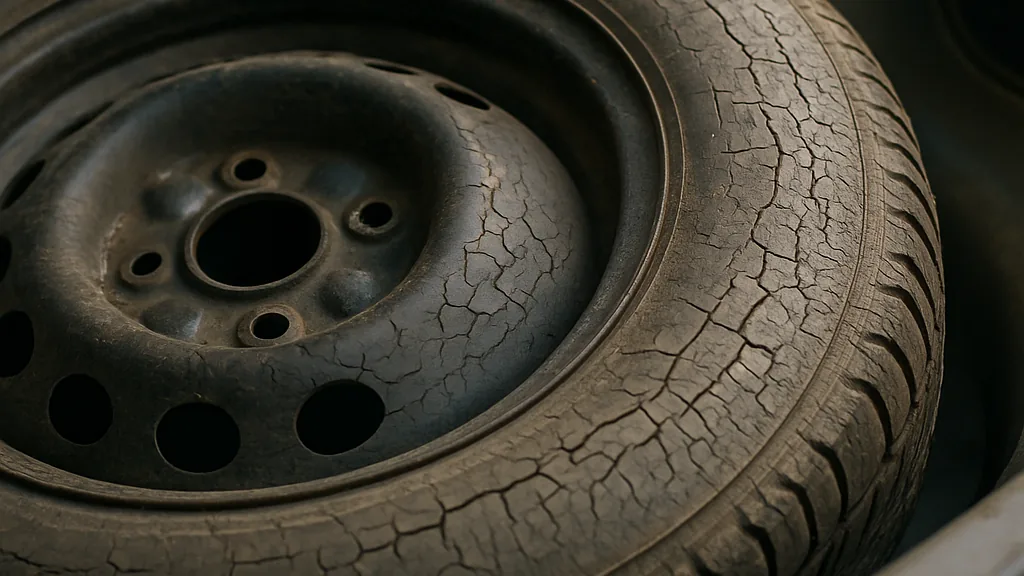
Why does a spare tire crack even if you never use it? A spare tire can crack, stiffen, and become unsafe to drive on even if it has never touched the road — because rubber ages through chemical reactions triggered by UV light, ozone, and heat, not by miles driven.
Key Takeaways
- Rubber degrades through oxidation, ozone attack, and UV radiation regardless of whether the tire has ever been driven on.
- Antiozonant and antioxidant additives in tire rubber deplete over time, leaving the compound brittle and vulnerable to surface cracking — a process that happens on the shelf, not on the road.
- Most automakers and tire manufacturers recommend replacing spare tires at 6–10 years from the manufacture date, regardless of tread depth or use.
- The DOT date code on the sidewall tells you exactly how old your tire is — the last four digits show the week and year of manufacture (e.g., “2319” = week 23 of 2019).
- Minimum legal tread depth in most U.S. states is 2/32 of an inch — but for an aged tire, structural condition matters more than tread depth.
- Externally mounted spare tires on Jeeps, SUVs, RVs, and 4x4s are generally considered to face greater UV and ozone exposure than trunk-stored spares, which may accelerate surface cracking over time.
- A spare tire cover blocks UV rays and reduces direct ozone contact — the two primary chemical drivers of rubber degradation on stored tires.
The Chemistry Behind Rubber Cracking (Even on a Shelf)
Tire rubber is a carefully engineered compound of natural or synthetic rubber, carbon black, plasticizers, and a suite of protective chemical additives — including antioxidants and antiozonants. These additives are the tire’s built-in defense system against environmental attack. Carbon black, the dark filler that gives tires their color, also provides a degree of UV protection — but it is not sufficient on its own to prevent long-term degradation, especially for tires stored in direct sunlight.
The problem is that the protective additives deplete over time, even when the tire sits perfectly still in your trunk. Once those chemicals are exhausted, the rubber is exposed to three relentless attackers — plus a fourth, road chemicals, that matters most for undercarriage-mounted spares.
Ozone attack: Ozone cracking occurs when ozone molecules in the atmosphere attack the carbon-carbon double bonds in rubber polymer chains. This breaks the molecular structure at the surface, creating the fine network of cracks you might recognize as dry rot. The process happens whether the tire is rolling or resting — ozone is always present in ambient air.
Oxidation: Oxygen reacts with rubber polymers in a slower but equally damaging process. Over years, oxidation hardens the rubber compound and makes it increasingly brittle.
Plasticizer migration: Plasticizers are added to rubber during manufacturing to keep it supple and flexible. Over time, these chemicals migrate to the surface of the tire and evaporate. As they leave, the rubber loses its flexibility and begins to harden and crack. Vehicle trunks can reach high temperatures in warm climates, which is widely considered to accelerate rubber aging and plasticizer migration in stored spare tires.
The Four Environmental Villains That Crack Your Spare
UV radiation, ozone, heat cycling, and road chemicals are the four forces that crack a stored spare tire — and all four act on the rubber whether or not the tire ever moves.
| Factor | Mechanism | Worst Storage Scenario |
|---|---|---|
| UV-Strahlung | Breaks polymer bonds at the rubber surface; accelerates oxidation | Exterior rear-door or bumper mount with no cover |
| Ozone | Attacks double bonds in rubber chains, causing surface cracks to propagate | Any unprotected exterior mount; urban environments with higher ambient ozone |
| Heat cycling | Repeated expansion and contraction accelerates plasticizer loss and micro-cracking | Dark trunk in a hot climate; black rubber absorbs heat rapidly |
| Moisture and road chemicals | Salt and road chemicals degrade rubber compounds and accelerate corrosion of the wheel | Undercarriage-mounted spare in a salt-belt region |
Where Your Spare Is Stored Matters More Than You Think
Not all spare tires age at the same rate. Where your spare lives between uses has a significant effect on how quickly these chemical processes advance.
Trunk or interior storage is the most protective environment. The tire is shielded from direct UV radiation and ambient ozone levels are lower indoors. Heat cycling still occurs in warm climates, but overall degradation is slower than any exterior mounting position.
Undercarriage mounts protect the tire from direct sunlight, which slows UV degradation meaningfully. The trade-off is exposure to road spray, salt, moisture, and debris — all of which can attack the rubber compound and accelerate corrosion of the wheel and mounting hardware. If you drive in a salt-belt region, inspect an undercarriage spare more frequently than you otherwise would.
Exterior rear-door or bumper mounts — common on Jeep spare tire covers customers, full-size SUVs, RVs, campers, and 4×4 vehicles — face the harshest conditions. Externally mounted spare tires are generally considered to face greater UV and ozone exposure than trunk-stored spares, which may accelerate surface cracking over time. Without a cover, an exterior spare receives a continuous dose of the two most damaging forces in rubber degradation every day it sits in the sun.
If you own a Jeep, G Wagon, or any vehicle with an exterior-mounted spare, this is the storage scenario that most urgently warrants a protective cover and regular inspection.
How to Read Your Spare Tire’s Age (DOT Date Code)
Your tire’s age is stamped right on the sidewall — you just need to know where to look. The DOT Tire Identification Number is a string of letters and numbers beginning with “DOT.” The last four digits of that string are the ones that matter for age.
Those four digits represent the week and year of manufacture. A code ending in 2319 means the tire was manufactured in the 23rd week of 2019. A code ending in 0422 means the 4th week of 2022.
Here is how to find it step by step:
- Look at the outer sidewall of the tire (the side facing away from the vehicle).
- Find the string starting with “DOT” — it may be partially on the inner sidewall on some tires.
- Count to the last four digits of the full DOT string.
- The first two digits = week of manufacture (01–52). The last two digits = year.
A tire can look perfectly fine — full tread, no visible cracking — and still be chemically aged past safe use. Tread depth alone is not a reliable safety indicator for an old tire. The DOT date code is the only objective measure of age.
Surface Crazing vs. Dangerous Cracks: How to Tell the Difference
Not every crack on a spare tire sidewall is an emergency — but some are. Dry rot typically appears first as a fine, shallow network of hairline cracks across the outer rubber surface, sometimes called surface crazing or tire blooming. This signals that the protective additives have depleted and degradation is underway, but early-stage crazing may still be cosmetic rather than structural.
Structurally dangerous cracks are a different matter entirely. Do not use a tire if you observe any of the following:
- Cracks that are deep enough to see into — not just surface discoloration
- Cracking in the bead area (where the tire meets the wheel rim) or in the sidewall flex zone
- Any cracking accompanied by bulging, bubbling, or visible deformation
- Cracks that run across the tread grooves rather than just along the sidewall surface
A practical rule: if you can insert a fingernail into the crack and feel depth, the tire’s structural integrity is compromised. Do not rely on it as an emergency spare. And remember — minimum legal tread depth in most U.S. states is 2/32 of an inch, but for an aged tire, structural condition is the more important test. A tire with 8/32 of tread remaining but deep sidewall cracks is not safe to drive on.
Can you use a spare tire with small cracks on the sidewall? Fine surface crazing alone is not an automatic disqualifier, but any crack with measurable depth, any crack near the bead, or any crack paired with bulging means the answer is no — replace it before you need it.
When Should You Replace a Cracked Spare Tire?
Replace your spare tire based on age, not appearance or mileage. Most automakers and tire manufacturers recommend replacing spare tires at 6–10 years from the manufacture date, regardless of use. Consumer Reports states a well-maintained spare tire should last up to ten years before needing replacement — but notes that six years is a common service interval recommendation from automakers.
The practical guidance:
- At 6 years: Have the tire professionally inspected. Many manufacturers consider this the first service interval.
- At 10 years: Replace the tire regardless of condition. This is the widely cited absolute maximum, even for tires with no visible cracking and correct pressure.
- At any age with visible structural cracks: Replace immediately. Do not wait for a scheduled interval.
For authoritative guidance on tire safety standards and age-based replacement, the NHTSA tire safety resource is a reliable reference point.
The Honest Counterpoint
If your vehicle is stored in a cool, dark, climate-controlled garage and the spare is an interior trunk-mounted spare that never sees direct sunlight, the rate of UV and ozone degradation is meaningfully slower. In such conditions, a tire at 7–8 years old with no visible cracking and correct pressure may still be serviceable — though the 10-year absolute maximum still applies and a professional inspection is warranted before relying on it. UV degradation slows significantly in the absence of direct sunlight, but it does not stop entirely, and ozone is still present even indoors at low concentrations.
3 Maintenance Habits That Slow Down Spare Tire Cracking
Three habits make a measurable difference: maintaining correct tire pressure, inspecting the sidewall every six months, and using a cover on any exterior-mounted spare. Here is how to put each into practice.
1. Check and maintain correct tire pressure monthly. Spare tires lose air pressure gradually even when unused. A significantly underinflated tire flexes more during storage and is more vulnerable to cracking at the sidewall. Check your vehicle manufacturer’s recommended PSI — usually printed on the door jamb sticker — and top up the spare at least once a month or before any long trip.
2. Inspect visually every six months. A quick look at the sidewall, bead area, and tread surface takes two minutes and can catch early crazing before it becomes a structural problem. Note the DOT date code during your inspection so you always know how old the tire is.
3. Use a spare tire cover. This is especially important for externally mounted spares on SUV spare tire covers applications — Jeeps, full-size SUVs, RVs, and 4×4 vehicles. A cover blocks UV rays and reduces direct ozone contact, the two primary chemical drivers of rubber degradation. It is the single most effective passive protection measure available for an exterior spare.
How a Spare Tire Cover Protects Against UV and Ozone Damage
A spare tire cover works as a physical barrier. By blocking direct UV radiation from reaching the rubber surface, it reduces the rate at which UV breaks down polymer bonds. By enclosing the tire, it also limits the concentration of ozone in direct contact with the rubber — slowing the ozone cracking process that causes dry rot. For trunk-stored spares, the benefit is moderate since UV exposure is already limited. For exterior rear-door and bumper-mounted spares, a cover provides genuinely meaningful protection, not just cosmetic appeal.
Wheel Shell produces individuelle Reserveradabdeckungen made from PU leather — a vinyl-family material with a non-porous, wipe-clean surface that limits UV penetration to the rubber beneath. PU leather shares these protective surface properties with marine-grade vinyl (both present a non-porous barrier to UV and ozone), but they are distinct materials: PU leather is lighter and has a softer texture, while marine-grade vinyl is typically heavier and more rigid. Wheel Shell covers are available for SUVs, Jeeps, G Wagons, RVs, campers, and 4×4 vehicles, with a free custom design service included on every order — you describe or upload your design, and they produce it. If you want something that protects your spare and looks good doing it, that is the practical option worth considering.
Häufig gestellte Fragen
Why does my spare tire crack if I’ve never driven on it?
Rubber degrades through oxidation, ozone exposure, and UV radiation even when stationary. Antioxidant and antiozonant chemicals added during manufacturing gradually deplete over time, leaving the rubber brittle and prone to surface cracking. Mileage has nothing to do with it — age and environmental exposure are the real drivers.
How old is too old for a spare tire?
Most automakers and tire manufacturers recommend replacing spare tires at 6–10 years from the manufacture date stamped on the sidewall, regardless of tread depth or mileage. Consumer Reports cites ten years as the outer limit for a well-maintained spare. If you see structural cracks at any age, replace it immediately.
How do I read the date code on my spare tire?
Find the DOT Tire Identification Number on the sidewall — it starts with “DOT.” The last four digits are the date code: the first two digits are the week of manufacture, the last two are the year. A code ending in “2319” means the 23rd week of 2019. A code ending in “0422” means the 4th week of 2022.
Are small surface cracks on a spare tire dangerous?
Fine surface crazing may be cosmetic in early stages, but cracks you can feel depth in, cracks near the bead or sidewall flex zone, or any cracking accompanied by bulging indicate structural compromise. Do not use a tire with deep or bead-area cracks as an emergency spare — replace it. UV degradation slows in the absence of direct sunlight but does not stop, so even a garage-stored spare with crazing warrants a professional look past the 8-year mark.
Does keeping a spare tire cover on slow down cracking?
Yes. A cover blocks UV rays and reduces ozone contact with the rubber surface — the two primary chemical drivers of rubber degradation. This is especially important for externally mounted spares on Jeeps, SUVs, RVs, and 4×4 vehicles, which face the highest UV and ozone exposure of any storage position.
Should I check the air pressure in a spare tire I never use?
Yes. Tires lose pressure slowly even when unused. Most full-size spares should be kept at the vehicle manufacturer’s recommended PSI. Check it at least once a month or before any long trip — an underinflated spare is more vulnerable to sidewall stress and cracking during storage.
Häufig gestellte Fragen
Why does my spare tire crack if I’ve never driven on it?
Rubber degrades through oxidation, ozone exposure, and UV radiation even when stationary. Antioxidant and antiozonant chemicals added during manufacturing gradually deplete over time, leaving the rubber brittle and prone to surface cracking. Mileage has nothing to do with it — age and environmental exposure are the real drivers.
How old is too old for a spare tire?
Most automakers and tire manufacturers recommend replacing spare tires at 6–10 years from the manufacture date stamped on the sidewall, regardless of tread depth or mileage. Consumer Reports cites ten years as the outer limit for a well-maintained spare. If you see structural cracks at any age, replace it immediately.
How do I read the date code on my spare tire?
Find the DOT Tire Identification Number on the sidewall — it starts with “DOT.” The last four digits are the date code: the first two digits are the week of manufacture, the last two are the year. A code ending in “2319” means the 23rd week of 2019. A code ending in “0422” means the 4th week of 2022.
Are small surface cracks on a spare tire dangerous?
Fine surface crazing may be cosmetic in early stages, but cracks you can feel depth in, cracks near the bead or sidewall flex zone, or any cracking accompanied by bulging indicate structural compromise. Do not use a tire with deep or bead-area cracks as an emergency spare — replace it. UV degradation slows in the absence of direct sunlight but does not stop, so even a garage-stored spare with crazing warrants a professional look past the 8-year mark.
Does keeping a spare tire cover on slow down cracking?
Yes. A cover blocks UV rays and reduces ozone contact with the rubber surface — the two primary chemical drivers of rubber degradation. This is especially important for externally mounted spares on Jeeps, SUVs, RVs, and 4×4 vehicles, which face the highest UV and ozone exposure of any storage position.
Should I check the air pressure in a spare tire I never use?
Yes. Tires lose pressure slowly even when unused. Most full-size spares should be kept at the vehicle manufacturer’s recommended PSI. Check it at least once a month or before any long trip — an underinflated spare is more vulnerable to sidewall stress and cracking during storage.
