
Uncategorized
Are Vinyl Tire Covers Better Than Fabric? A Straight-Talking Material Comparison
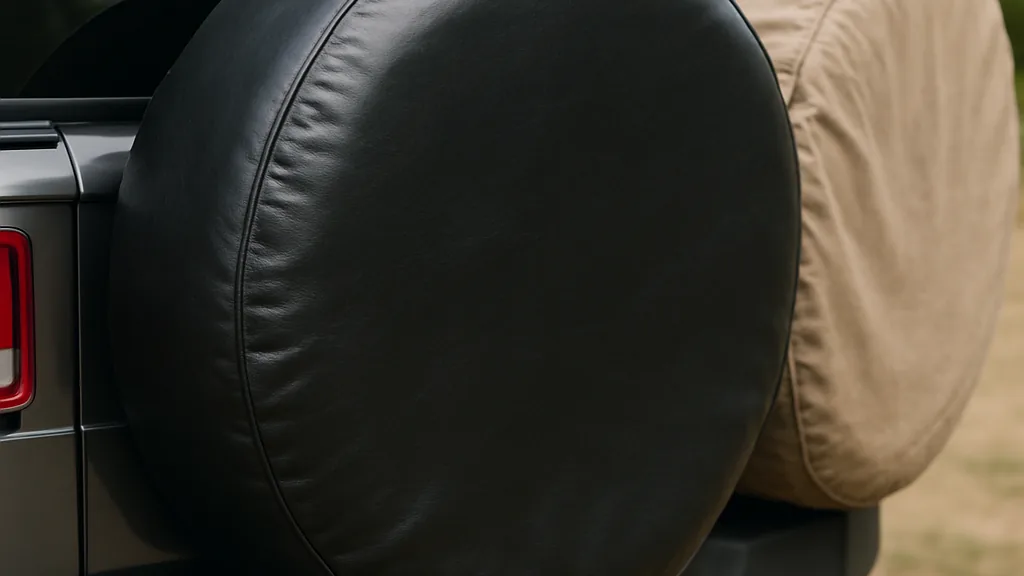
Aug
Are vinyl tire covers better than fabric? For any spare tire exposed to sun, rain, or road conditions — yes, decisively. Vinyl and PU leather covers resist UV radiation, repel water, and hold up for multiple seasons outdoors, while porous fabric materials fade within weeks and trap moisture that breeds mildew. Fabric remains a reasonable choice only for short-term indoor storage.
A quick note on materials before we dive in: Wheel Shell covers are made from PU leather (polyurethane leather) — a vinyl-family synthetic with a non-porous surface and UV-blocking coating applied over a fabric backing. PU leather shares the core protective properties of marine-grade vinyl but is a distinct material; marine-grade vinyl is a solid-through synthetic with no fabric layer, while PU leather uses a polyurethane coating bonded to a woven substrate. Both are covered in this comparison alongside standard fabric options.
Key Takeaways
- Vinyl and PU leather tire covers contain UV inhibitors that protect both the cover and the tire sidewall from sun damage; fabric offers little to no UV protection.
- Fabric tire covers (polyester, nylon, canvas) are porous — they absorb moisture, increasing mildew and mold risk, and can freeze solid in winter when saturated with water, becoming stiff and difficult to remove without tearing.
- Marine-grade vinyl covers typically last several years in outdoor conditions, depending on climate and maintenance; PU leather covers are generally expected to provide durable outdoor performance for multiple seasons, though lifespan varies by climate and care.
- Vinyl and PU leather wipe clean with a damp cloth — avoid petroleum-based cleaners that can degrade the UV coating; fabric may require machine washing and risks mildew if stored damp.
- Fabric covers are a legitimate choice for indoor or garage storage where UV and moisture are not concerns.
- PU leather (Wheel Shell’s material) supports full custom printing — photos, logos, themed patterns — with designs that stay vivid longer than printed fabric alternatives exposed to sun.
Quick Comparison: Marine-Grade Vinyl vs. PU Leather vs. Fabric
| Feature | Marine-Grade Vinyl | PU Leather (Wheel Shell) | Fabric (Polyester / Nylon) |
|---|---|---|---|
| UV resistance | ✅ High — UV inhibitors built in | ✅ High — UV-blocking coating | ❌ Low — fades within weeks outdoors |
| Waterproof | ✅ Non-porous, fully waterproof | ✅ Non-porous, fully waterproof | ❌ Porous — absorbs moisture |
| Mildew risk | ✅ Very low | ✅ Very low | ❌ High — traps moisture against tire |
| Winter performance | ✅ Stays flexible, sheds ice | ✅ Stays flexible, sheds ice | ❌ Absorbs water, freezes stiff |
| Outdoor lifespan | Several years (climate/care dependent) | Multiple seasons (climate/care dependent) | Weeks to months before visible degradation |
| Fit and appearance | Smooth, tailored, form-fitting | Smooth, tailored, form-fitting | Often loose, wrinkled over time |
| Cleaning ease | Wipe clean with damp cloth | Wipe clean with damp cloth | Machine wash required; mildew risk if stored damp |
| Custom design | Available (varies by brand) | ✅ Full custom printing — free design service, worldwide shipping | Available but design fades faster outdoors |
| Best for | Outdoor, marine, heavy-duty use | Outdoor SUV, Jeep, RV, G Wagon — custom look | Indoor/garage storage only |
What Are Vinyl Tire Covers Made Of?
Marine-grade vinyl is a heavy-duty synthetic material engineered for outdoor exposure. It contains UV inhibitors — chemical compounds integrated throughout the material that absorb and scatter ultraviolet radiation before it can break down the surface or the tire sidewall underneath. The surface is non-porous, meaning water beads off rather than soaking in, and the material resists road salt, mud, and ozone degradation that would quickly compromise a woven fabric.
PU leather (polyurethane leather) is a related but distinct vinyl-family material. It uses a polyurethane coating bonded over a woven fabric backing to create a smooth, non-porous outer surface with a UV-blocking layer. The fabric backing gives PU leather its structural flexibility, while the polyurethane top layer provides the weather resistance. Wheel Shell uses PU leather for its covers — it shares the wipe-clean, weather-resistant character of marine-grade vinyl while offering a refined finish well-suited to custom printing. The two materials are not identical: marine-grade vinyl is a solid-through synthetic optimized for marine environments, while PU leather balances outdoor durability with a polished aesthetic that suits Jeep, SUV, and G Wagon owners who want their vehicle to look as good as it performs.
What Are Fabric Tire Covers Made Of?
Standard fabric tire covers — polyester, nylon, or canvas — are porous materials that offer minimal UV protection and absorb moisture readily, making them unsuitable for sustained outdoor exposure. That’s the bottom line; the material specifics explain why.
Most fabric covers are woven from the same fibers used in outdoor clothing and bags. Woven fabrics have microscopic gaps between threads that allow water, dust, and UV radiation to pass through to the tire surface. Most standard fabric covers contain no UV inhibitors. Some premium versions apply surface coatings for limited water resistance, but those coatings wear off with washing and sun exposure, leaving the underlying weave unprotected. Canvas is more durable than lightweight polyester but still absorbs moisture and lacks the sustained UV-blocking properties of vinyl-family materials.
How UV Resistance Differs Between Vinyl-Family and Fabric Covers
Vinyl-family covers block UV meaningfully; standard fabric covers do not — and the gap in real-world performance is significant. UV radiation and ozone are the primary environmental causes of tire sidewall cracking and degradation. A cover that blocks UV protects not just itself but the rubber underneath.
Marine-grade vinyl and PU leather both carry UV-blocking coatings that resist fading and maintain structural integrity through seasons of sun exposure. Fabric covers, by contrast, can fade visibly within weeks of outdoor sun exposure. As the dye breaks down, the fibers themselves become brittle — and a brittle cover offers progressively less protection to the tire it’s supposed to shield. UV degradation slows below freezing but doesn’t stop, so even winter-parked vehicles benefit from UV-resistant covers. A fabric cover that looks presentable in October can look washed-out and stiff by the following spring — and the tire sidewall it was meant to protect has been absorbing UV the entire time.
Water, Moisture, and Weather Protection
Vinyl and PU leather are non-porous and effectively waterproof — rain runs off the surface and the tire stays dry. A wet cover pressed against rubber for 48 or more hours accelerates the same oxidative degradation that UV causes from above, so keeping moisture away from the tire sidewall matters as much as blocking sunlight.
Fabric covers absorb water. After a rainstorm, a polyester or nylon cover can hold significant moisture against the tire for hours or days. In freezing temperatures, that absorbed water turns to ice — the cover becomes stiff, heavy, and difficult to remove without tearing the material or the elastic hem. Road salt from winter driving compounds the problem: salt-laden moisture trapped in fabric fibers accelerates both fabric breakdown and potential corrosion of any metal hardware on the cover.
Mold and mildew follow naturally from trapped moisture. Because vinyl and PU leather are non-porous, water has nowhere to collect — the surface dries quickly after rain. Fabric covers in humid climates or rainy seasons can develop mildew within days of being stored damp, and that mildew smell signals that the cover is no longer doing its job cleanly.
Durability and Lifespan: How Long Does Each Material Last?
Marine-grade vinyl tire covers typically last several years in outdoor conditions, depending on climate and maintenance. Covers used in high-UV environments — the desert Southwest, coastal regions with salt air — will age faster than those in milder climates, but the built-in UV inhibitors meaningfully extend service life compared to unprotected materials.
PU leather covers are generally expected to provide durable outdoor performance for multiple seasons, though lifespan varies by climate and care. Wiping the surface periodically with a damp cloth — and avoiding petroleum-based cleaners that can degrade the UV-blocking coating — helps maintain performance over time.
Fabric covers degrade much faster under outdoor conditions. Visible fading can appear within weeks; structural weakening — fraying edges, thinning fabric, failing stitching — typically follows within months of regular sun and rain exposure. A fabric cover that looks fine in a garage will look worn within a single summer on a rear-mounted spare exposed to daily driving conditions.
Fit and Appearance
Vinyl and PU leather covers hold their shape through multiple seasons; fabric covers typically loosen and wrinkle within months as elastic hems stretch and the weave relaxes under repeated wet-dry cycles.
Vinyl-family covers achieve their fit through a combination of elastic hem construction and the material’s controlled surface tension — the non-porous outer layer resists the stretching and relaxation that woven fabrics undergo when wet and dried repeatedly. The result is a smooth, tailored profile with no sagging, no wrinkling, and no fabric bunching at the edges. PU leather’s smooth surface also resists surface scratching from road debris and trail brush better than woven fabric, which can snag and pill over time.
Fabric covers loosen as elastic hems fatigue and the weave relaxes. The cover develops a baggy, wrinkled appearance that looks worn even when the material is still technically functional. On a Mercedes-Benz G-Class or a lifted Jeep Wrangler, where the rear-mounted spare is one of the most visible elements of the vehicle from behind, a sagging fabric cover undercuts the vehicle’s aesthetic in a way that a form-fitting PU leather cover does not.
Cleaning and Maintenance
Vinyl and PU leather covers are straightforward to maintain: wipe the surface with a damp cloth to remove dust, mud, or road grime. Avoid petroleum-based cleaners — solvents can degrade the UV-blocking coating over time, shortening the cover’s effective outdoor lifespan. Routine cleaning takes minutes rather than a trip to the washing machine, and the non-porous surface doesn’t hold dirt the way woven fabric does.
Fabric covers require more effort. Most need machine washing to clean properly, and machine washing accelerates wear on elastic hems and printed designs. If a fabric cover is stored while still damp — after a rainstorm, for example — mildew can develop within days, particularly in warm climates. That mildew smell is difficult to remove and signals that the cover is no longer doing its job cleanly.
Vehicle-Specific Considerations
For Jeeps, RVs, and premium SUVs with exposed rear-mounted spares, vinyl-family covers are the only practical outdoor choice — the specific demands of each vehicle type reinforce the same conclusion from different angles.
Jeep Wrangler, Gladiator, and 4×4 vehicles: The rear-mounted spare on a Jeep is fully exposed to sun, rain, mud, and road spray every time the vehicle moves. Trail use adds abrasion from brush and debris. This is the harshest use case for any tire cover — constant UV exposure, repeated soaking, and physical contact with vegetation and rocks. Jeep spare tire covers made from vinyl-family materials are the practical choice here; fabric simply won’t hold up through a full season of trail use and daily driving. The same logic applies to Land Rover Defenders, Toyota 4Runners, and other 4×4 vehicles with rear-mounted spares.
RVs and Campers: RVs are often parked for weeks or months at a time, stationary in full sun and rain with no movement to air out the cover. This extended, uninterrupted UV and moisture exposure is exactly the scenario that destroys fabric covers fastest — there’s no reprieve from the elements between trips. Vinyl is not just preferred for RV tire covers; for any RV parked outdoors for more than a few days at a stretch, it’s the only material that will still look and function correctly at the end of the season.
Mercedes-Benz G-Class and Premium SUVs: For G Wagon owners, appearance is part of the equation alongside protection. A tailored PU leather cover with a custom design maintains the vehicle’s premium look in a way that a loose, sun-faded fabric cover cannot. The material choice here is as much aesthetic as functional — and PU leather delivers on both.
When a Fabric Cover Is Good Enough
Fabric tire covers are a reasonable choice when the spare tire is stored indoors, in a garage, or in a covered environment where UV exposure and moisture are not concerns. In those scenarios, a lightweight fabric cover adequately protects against dust and minor abrasion at a lower cost. The material’s weaknesses — UV fading, moisture absorption, mildew risk, freezing in winter — become irrelevant when the cover never sees sunlight or rain. If your spare tire lives in a climate-controlled garage and the vehicle is only driven occasionally in dry conditions, a fabric dust cover does the job without the added cost of a vinyl-family alternative.
Step outside that scenario — rear-mounted spare, regular outdoor parking, any climate with meaningful rain or sun — and fabric stops being adequate. It’s not a long-term outdoor material for this application, and the degradation timeline is short enough that the cost savings disappear quickly when the cover needs replacing after a single season.
Custom Design: Does Material Affect Personalization?
Both fabric and vinyl-family materials can be printed with custom designs, but the longevity of that design differs significantly — and so does the range of what’s possible.
PU leather supports full custom printing: photos, logos, illustrated patterns, themed graphics, and text. The UV-blocking coating that protects the material also shields the ink layer underneath, so printed designs stay vivid through multiple seasons of outdoor use rather than washing out after a single summer. There are no meaningful resolution constraints for well-prepared image files — the print process handles photographic detail as readily as simple graphics.
On a fabric cover, UV exposure fades printed designs at the same rate it fades the base material — often within a single season outdoors. A custom design on fabric is a short-term aesthetic choice; the same design on PU leather is a durable one. Wheel Shell includes a free custom design service with every order: customers submit a description or image, and the design is created at no extra charge, with free worldwide shipping and a 2–5 business day processing time. Browse custom spare tire covers to see the range of themes and vehicle fitments available.
Final Verdict
For any spare tire that lives outdoors — rear-mounted on a Jeep, sitting on an RV in a campground, or exposed on an SUV in daily use — vinyl and PU leather covers are the clear choice. They block UV radiation, repel water, resist mildew, maintain their shape, and hold up for multiple seasons. Fabric covers are not built for this environment, and the degradation timeline is short enough that the cost difference becomes irrelevant within a season.
That said, fabric deserves genuine credit for one scenario: indoor and garage storage. If your spare tire never sees direct sunlight or rain, a lightweight fabric cover is a perfectly functional dust shield. Its weaknesses simply don’t apply in that environment, and there’s no reason to spend more than necessary for a cover that lives in a climate-controlled space.
Wheel Shell, based in Sheridan, Wyoming, makes its covers from PU leather — a vinyl-family material that delivers UV resistance, waterproofing, and wipe-clean maintenance with a refined finish suited to custom printing. Every order includes a free custom design service, and covers ship worldwide at no extra charge.
Frequently asked questions
Are vinyl tire covers better than fabric for outdoor use?
Yes, decisively. Vinyl and PU leather resist UV radiation, repel water, and resist mildew far better than fabric alternatives. Fabric covers (polyester, nylon, canvas) are porous, fade within weeks of sun exposure, and absorb moisture that can lead to mold. Fabric is only a reasonable choice for indoor or garage storage where UV and moisture are not factors.
How long do vinyl tire covers last compared to fabric?
Marine-grade vinyl covers typically last several years in outdoor conditions, depending on climate and maintenance. PU leather covers are generally expected to provide durable outdoor performance for multiple seasons, though lifespan varies by climate and care. Fabric covers can show visible fading within weeks and structural degradation — fraying, thinning, failing stitching — within months of regular outdoor exposure.
What is PU leather and how does it compare to vinyl for tire covers?
PU leather (polyurethane leather) is a vinyl-family synthetic with a non-porous polyurethane coating over a woven fabric backing. It shares the core protective properties of marine-grade vinyl — waterproof, wipe-clean, UV-resistant — but is a distinct material. Marine-grade vinyl is a solid-through synthetic optimized for heavy-duty marine use; PU leather balances outdoor durability with a refined finish suited to custom printing.
Are vinyl tire covers waterproof?
Yes. Marine-grade vinyl and PU leather are both non-porous, meaning water cannot penetrate the surface. Rain beads off and the tire stays dry. Fabric covers, by contrast, are porous and absorb moisture — a wet fabric cover pressed against a tire for hours or days accelerates rubber degradation and creates conditions for mildew growth.
Do fabric tire covers protect against UV damage?
No, not meaningfully. Most standard fabric covers contain no UV inhibitors and offer little protection against ultraviolet radiation. They fade quickly outdoors and become brittle as the fibers break down, leaving the tire sidewall increasingly vulnerable to UV and ozone degradation — the primary causes of tire sidewall cracking. Even premium fabric covers with surface UV coatings lose that protection faster than the built-in inhibitors in vinyl-family materials.
What is the best tire cover material for a Jeep spare tire?
Marine-grade vinyl or PU leather are the top choices for a Jeep’s rear-mounted spare. Jeep Wranglers and Gladiators expose their spare to constant sun, rain, mud, and road spray on every drive — plus abrasion from trail use. Fabric covers won’t survive a full season in those conditions. Vinyl-family materials handle the UV exposure, moisture, and physical contact that Jeep owners encounter regularly.
When is a fabric tire cover good enough?
Fabric covers are adequate when the spare tire is stored indoors, in a garage, or in any covered environment where UV exposure and moisture are not concerns. In those conditions, a lightweight fabric cover protects against dust and minor abrasion at a lower cost, and its weaknesses — UV fading, moisture absorption, freezing in winter — simply don’t apply. Step outside that scenario and fabric stops being adequate.
Can you get a custom design on a vinyl or PU leather tire cover?
Yes. PU leather supports full custom printing — photos, logos, illustrated patterns — and the UV-blocking coating helps preserve the design through multiple seasons outdoors. Wheel Shell includes a free custom design service with every order: submit a description or image and the design is created at no extra charge, with free worldwide shipping and a 2–5 business day processing time.
